The Rover 54
Rover Yachts & Hull Vane – a golden match
Managing director Bruno Bouckaert talks about his collaboration with Rover Yachts
More speed with less power, small stern waves and less tilt and roll. These are some of the advantages the new Rover 54 benefits from through the use of the Hull Vane. Due to its aluminium construction, the Rover is lightweight and the Hull Vane could also be relatively small on this yacht. YachtFocus sat down with Bruno Bouckaert, general manager of Hull Vane, to discuss the considerations for the Hull Vane on the Rover.
How did the collaboration with Rover Yachts begin?
Bouckaert: ‘We had been in contact with the creators of the Rover for some time. They knew the Hull Vane and its advantages. When the plan for a new vessel arose, it just made sense to involve the Hull Vane directly in this. The concept of the ship as a long-range scout fits the Hull Vane very well by its features alone. And thanks to the semi-custom Hull Vane we offer, it is also very affordable for shipyards and owners. After all: a boat usually lasts for 20 to 30 years, sometimes much longer. So it makes sense to make a small additional investment in the beginning and then be able to use the boat throughout its lifetime with permanently lower operating costs. We call this Future Proofing.
But shipyards and owners need to understand this first.
Indeed. We see three types of shipyards. The first see nothing in the Hull Vane and offer it only if the customer explicitly asks for it. The next offer it as an option. For the third, it is just standard.
What is so special about the project and the Rover 54?
In this segment, it is one of the first with the Hull Vane as standard equipment and not as an option. This makes the customer’s choice very easy. This size vessel is often sailed on inland waterways, where you regularly get complaints from people on houseboats and other water sports enthusiasts because the waves are too big. The consequence: you sail slower. But that’s no fun and you can’t really move forward. So it’s great if the boat causes fewer waves. Often the water in the stern is shallow, causing the stern to sink. This is called the squat effect. This too is reduced with the Hull Vane, increasing the efficiency of the hull even in shallow water.
How is the collaboration with Rover Yachts going?
Very well. Construction of the first Hull Vane for Rover is yet to start, but so far it has gone smoothly.
How important is it to include the Hull Vane in the design phase of a new yacht?
We supply about half of the systems for a retro-fit, i.e. as an addition to an existing yacht. The other half is for new builds. If the yacht yard involves Hull Vane in the plans from the beginning, the process is naturally easier and cheaper. And the yard automatically benefits from other advantages too: for example, if a maximum speed has been agreed that must be reached, the yard can plan smaller engines from the start. And if a certain range is known, smaller tanks can also be installed. The exhaust system can be smaller, and so on. In this way, you can optimise the ship hydrodynamically and end up in a positive spiral. But this advantage only exists if you plan with the Hull Vane from the start.
Are there any other advantages?
Yes, the noise level on the aft deck is lower because there is less turbulence behind the ship. So people can talk to each other quietly on the aft deck, a place where many people like to be when the ship is sailing. The difference ran up to 6 db(a), which is what we measured. That’s huge. And: with a retrofitted Hull Vane, you can achieve the same speed with fewer revolutions per minute. That also makes it quieter. And, of course, you save fuel.
Are there certain types of boats that are particularly suitable for using a Hull Vane?
Explorer yachts, or in other words, yachts that are sailed a lot and are not built as a caravan on the water. Boats for long distances, even at sea. They often have a less full bow for better performance in rough seas. Logically, customers who sail a lot will find the investment in the Hull Vane more worthwhile. In rough seas, the Hull Vane also helps by dampening movement.
What do you think of the Rover 54?
I find it an attractive powerboat. Robust and stable, it’s more like a work boat. That appeals to me a lot. The boat says what it does just by its looks.
How will the world of motor yachts continue to evolve?
The sustainability theme will definitely keep us busy. In terms of propulsion, it hardly matters whether it continues with hydrogen and/or electricity. Hydrodynamic efficiency will receive more and more attention, just like aerodynamics in electric cars. Any improvement will be reflected in greater range. With the Hull Vane, the question is not whether it is worth it, it always is anyway, no matter what energy source is used for propulsion. Especially, if you use the vessel more often. Anything that reduces hull drag today will pay off in the future. So it doesn’t matter which propulsion system is installed. And what aerodynamics is for cars, hydrodynamics is water resistance for ships. Unfortunately, there is no spoiler for cars that can increase range by 10-20% overnight. For motor yachts, such an application does exist and we call it: the Hull Vane.
Want to know more? For more information, visit
www.roveryachts.com
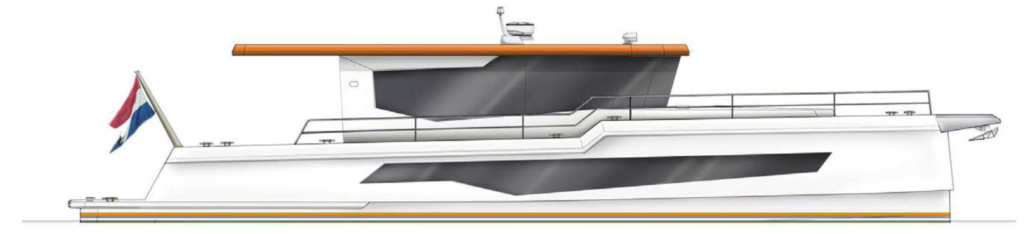
Description of the AVATAR III
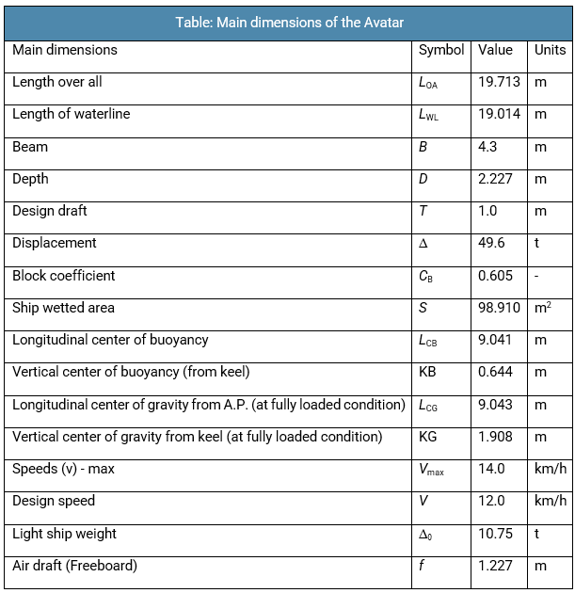
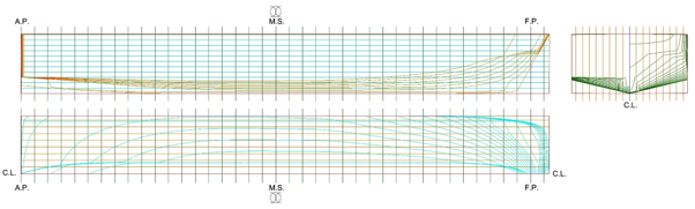
Ship hydrostatics of the AVATAR vessel
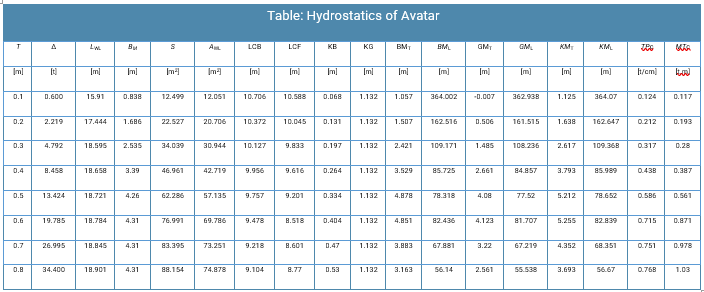
The hydrostatic analysis is the first and the most important analysis that should be performed in the early design stage of the ship. The analysis results in the main parameters and characteristics of the studied ship such as, displacement, submerged and waterplane areas, form coefficients, position of the centers of floatation and buoyancy, metacentric height, etc. These are usually predicted at various ship draft and finally reported in forms of tables and plotted diagram called the ship hydrostatics diagram. The next Table gives the results for the hydrostatic analysis of the Avatar, while the Figure plots the hydrostatic diagram for the Avatar.
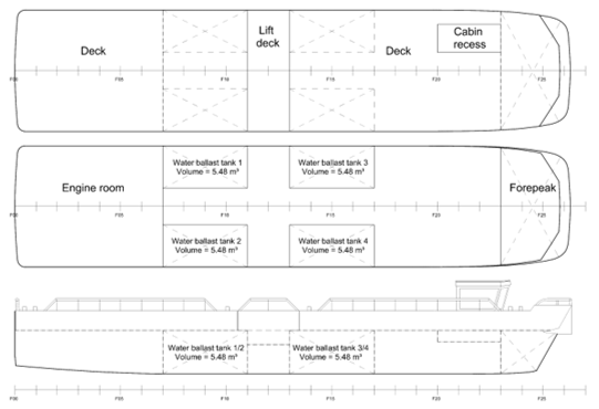
Compartments and tank plan
Electric propulsion
H2 – fuelcell
motorisation from 15 hp – 200 hp
Batteries MG or others
Fuel cells
Battery management system (BMS)
Ship Management System (SMS)
Remote control systel
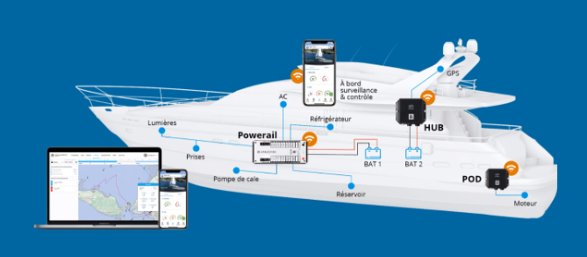
Ernergy & Ship Management
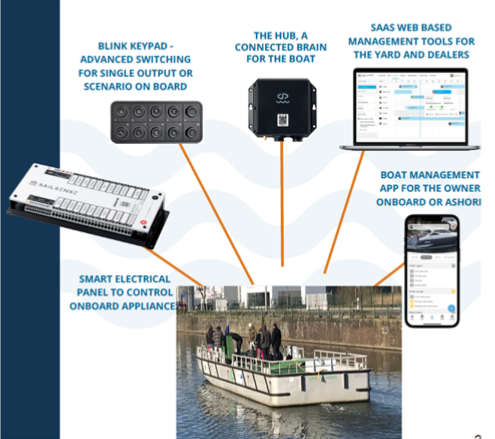
Equipment installation on board
Connection with remote control
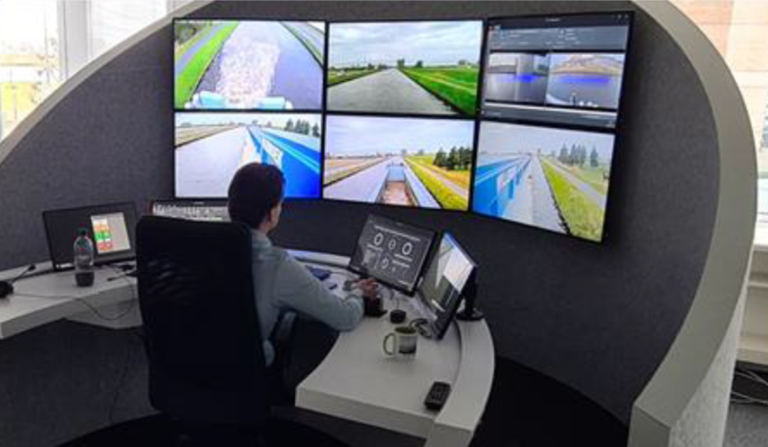
Command Center
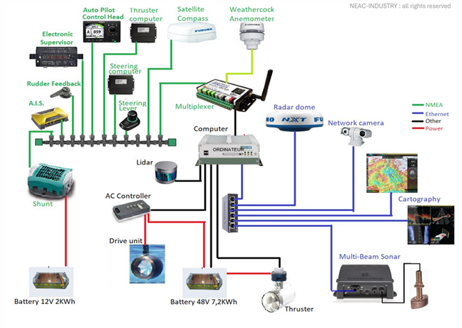
All possible sensors can be added
Connection software to Dataspace
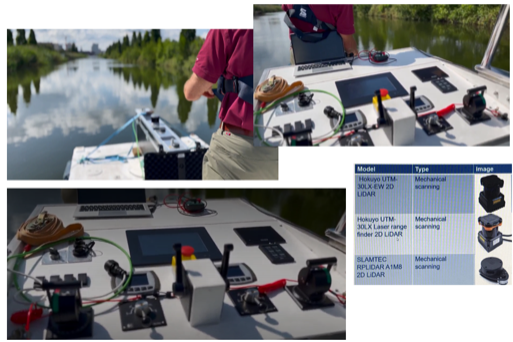
Research equipment available
Testsails in seacanal and urban environment,…
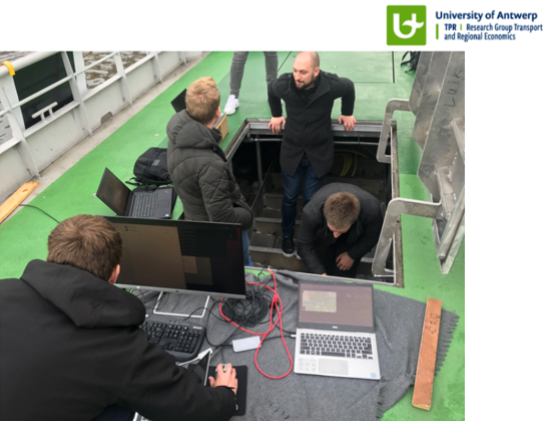
Due to the fact that various types of ships are available in a real life urban environment and there are many questions from European research institutions, these vessels, infrastructure and know-how have been housed in a Research and Innovation Center to make them available to these research institutions for further development. research. In this way, knowledge and experience are shared for further research and not every project or research institution has to do a simulation every time or build a new DT or data space.
Overview of some tests